International relations are like ex-girlfriends: if you're still deluding yourself you can get her back, every encounter will perforce be fraught and turbulent; once you realise that's never gonna happen, you can meet for a quick decaf latte every six – make that 10 – months and do the whole hey-isn't-it-terrific-the-way-we're-able-to-be-such-great-friends routine because you couldn't care less. You can even make a few pleasant noises about her new romance (the so-called European Constitution) secure in the knowledge he's a total loser.
Mark Steyn
Friday, February 25, 2005
Old Europe & Old Love
Thursday, February 24, 2005
Sharon on France
Prime Minister Ariel Sharon told television talk-show host and comedian Eli Yatzpan that France favored the Arab states, and criticized its refusal to condemn Hezbollah as a terrorist organization.
"First of all, the French are pro-Arab," Sharon told Yatzpan yesterday in an interview conducted while strolling around Sharon's ranch.
"One of the strangest things is that France is not prepared in any way to define Hezbollah as a terror group, though it is one of the most dangerous ones in existence," he said, referring to the Lebanon-based group.
Haaretz
"The Berlin Wall Has Fallen"
The leader of this Lebanese intifada is Walid Jumblatt, the patriarch of the Druze Muslim community and, until recently, a man who accommodated Syria's occupation... Over the years, I've often heard him denouncing the United States and Israel, but these days, in the aftermath of Hariri's death, he's sounding almost like a neoconservative. He says he's determined to defy the Syrians until their troops leave Lebanon and the Lahoud government is replaced.
It's strange for me to say it, but this process of change has started because of the American invasion of Iraq," explains Jumblatt. "I was cynical about Iraq. But when I saw the Iraqi people voting three weeks ago, 8 million of them, it was the start of a new Arab world." Jumblatt says this spark of democratic revolt is spreading. "The Syrian people, the Egyptian people, all say that something is changing. The Berlin Wall has fallen. We can see it."
Washington Post
Second Thoughts: Bush in Germany
When the voter turnout in Iraq recently exceeded that of many Western nations, the chorus of critique from Iraq alarmists was, at least for a couple of days, quieted. Just as quiet as the chorus of Germany experts on the night of Nov. 9, 1989 when the Wall fell.
Just a thought for Old Europe to chew on: Bush might be right, just like Reagan was then.
Der Spiegel
Hat Tip: Chrenkoff
Wednesday, February 23, 2005
Good News from Gaza
Palestinian Prime Minister Ahmed Qureia does not intend to present a new cabinet for parliamentary approval on Wednesday or Thursday, sources close to Qureia said on Wednesday.
In such a case, Palestinian Authority Chairman Mahmoud Abbas may decide as early as Thursday to entrust the task of forming a new government on a new candidate for the premier post.
"There is an internal plot in the [Palestinian ruling party] Fatah to hamper any cabinet presented he will present, and therefore he does not intend to do so," the sources close to Qureia said.
Haaretz
See also debka's report about Dahlan's assassins - "Dahlan’s Death Squads Bring a Bit of Iraq to Gaza Strip". I still think overall this guy is a good influence in Gaza - despite his shortcomings - which doesn't say much about the Gaza leadership slate.
Palestinian legislature continues to withhold confirmation from PM Qureia’s cabinet even after he scrapped first lineup and promised professionals, except for two ministers, instead of corruption-tainted veterans.
Main opposition comes from Qureia-Abbas’ own Fatah majority. DEBKAfile reports PA Chairman Abbas is manipulating Fatah to sustain crisis and humiliate Qureia until he quits. PM expected to resign if no majority Thursday.
Debka
Tuesday, February 22, 2005
Tony & Son
An Australian reunion with a twistAn Australian minister who was reunited with the son he placed for adoption 27 years ago found out they had been working in the same building.
Abbott says he want to make a fresh start with his new-found son
Health Minister Tony Abbott said he was "flabbergasted" when he was contacted by Daniel O'Connor, the boy he and his teenage girlfriend last saw in 1977.
Both men realised they had been working close by in parliament where Mr O'Connor is a sound technician.
"I think it is a wonderful story," said Prime Minister John Howard.
Mr Abbott told reporters about his Christmas reunion with the son he had last held as a five-day-old baby.
BBC News (For more of the story, click on the link)
A nice, heartwarming story! And for those who will no doubt try and portray Mr Abbott as hypocritical due to his conservative stance on abortion, the opposite is true. Adoption, in many cases, is a viable alternative to abortion. And unlike abortion, and adoption results in all parties benefiting (even 27 years later...) including the biological parents, the step parents and most of all - the child. The latter point is emphasised by Daniel's first words to his biological father: "Thank you for having me".
An Ode to Chrenkoff
Also, check out his killer (excuse the pun) news roundup from Lebanon.
An Enemy Called...
Linda Heard is a British editor, journalist and columnist currently based in Cairo where she is a correspondent for the English-language Saudi daily The Arab News...
Linda’s road has often been a lonely one since she refuses to align herself with any political system, party, activist group, or campaigning society. Without the constraints of ‘belonging’ and having to toe an official line, she strives to be an objective observer of the international political arena [Neo: Thesis].
...“When I hear the hauntingly beautiful call of the muezzin, I know I’m home,” she is known to say. [Neo: Anti-thesis]
Due to decades of witnessing so many good things about Arab culture - hospitality, compassion, charity and respect for family values - Linda feels that the Arabs, and even Islam, are currently being maligned by leaders of Western powers to suit their own power-led agendas. [Neo: Syn-thesis?!]
Palestine is occupied. Iraq is occupied. Afghanistan, the Middle East, Gulf and the Caspian are seething with US military personnel, pilots, submarines, Apache gun-ships, fighter jets and spy drones. Iran and Syria are being threatened [Neo: Oh No!!! Heaven forbid!]. And yet, it is absolutely imperative that Syria quits Lebanon tout suite, or so goes the White House line.
Naturally, the vast majority of the Lebanese want a complete Syrian withdrawal in the same way that Palestinians want to reclaim their land and Iraqis want the invaders out (except those in government suffering from severely twisted arms [Neo: by the hands of the terrorists or the Americans?!]). What human being on earth wants foreigners dictating their “do’s and don’ts” or telling them how their country should be run?
But there is a fundamental difference between the Syrian “occupation” and the others previously mentioned. The Syrians were invited into Lebanon in 1976 when the country’s civil war was at its bloodiest to bring stability [Neo's Newsflash: The Israelis were also invited to protect the Christians and were greeted with rice and flowers in 1982]. Over time, this it helped to achieve [Neo: would you also credit Israel with that?! Would you also credit the USSR for promoting global stability through MAD - technically true but odd...].
Furthermore, the Syrians have long said they have a plan for a staged withdrawal [Neo: staged over another 31 years, no doubt], which is more than one can say for the Americans in Iraq. Indeed, its troop levels are already substantially down.
...Put simply, the Syrians have overstayed their welcome, although given that Lebanon doesn’t possess an army to speak of, it has always maintained it would leave when the Israelis quit Lebanese land (there is still the Shiba Farms issue outstanding) and the Palestinians received their much-coveted state [Neo: Hold on a sec, the problem with Israel giving back Shiba Farms to Lebanon is that Syria is the country that is laying claim to the small land area. Further, the UN confirmed it was never part of Lebanese territory and as such concluded that Israel withdrew in full. So, no issues are outstanding! And as for the "much-coveted" Palestinian state - what does that have to do with Syria's occupation of Lebanon. Are they holding a fellow Arab country at ransom for the sake of a third Arab national group]. At the same time, Syria has long been attempting to hold peace negotiations with Israel, which still occupies its strategic Golan Heights, but has been constantly rebuffed [Neo: For two important reasons: 1) Sharon is not going to offer Assad a breather when the pressure cooker is on 2) Barak's attempts proved that Israel cannot negotiate on two fronts at the same time for internal reasons].
In addition, Syria was a main player in the “war on terror” during the months following the Sept. 11 attacks in the US [Neo: Interesting hypothesis] when both No. 10 and Buckingham Palace received Bashar and his wife as honored guests. What has changed?
...Then along came the tragic assassination of Lebanon’s former and widely beloved Prime Minister Rafik Hariri in Beirut’s downtown, which he so lovingly restored. Who did it?
“Syria,” said the US in nonverbal terms by withdrawing their ambassador and demanding the immediate Syrian pull out of Lebanon. No proof, nothing.
In the same way that individuals have been branded as terrorist supporters and bundled off in chains to Guantanamo, Bagram or Abu Ghraib, so Syria has been effectively labeled Hariri’s killer [Neo: I can't pin point why, but this victim story isn't working for me. Maybe if I see Assad sexually humiliated...].
For its part, Syria maintains Hariri was a friend [Neo: That's news to us all including Hariri and Syria itself] and has pointed out that it wouldn’t be in its interests to have him killed, especially in the light of so many international knives out for its blood. What could Syria possibly have to gain? We shouldn’t forget, too, that Bashar is highly educated and intelligent, not someone who would be stupid enough to believe Syria could get away with such an outrageous act [Neo: So, unlike the past half a dozen political assassinations committed by Syria, they now have a dentist at the realm who wouldn't dare do anything but remove Hariri's plaque].
Unfortunately, those Lebanese, who have united against Syria following Hariri’s demise, have fallen right into the trap.
Once again, Syria is not the aggressor here... [Neo: "Once again", let's ignore its acts of aggression of 1948, 1967, 1973, 1974, 1982, 2003, etc.] It is time for the Lebanese to decide where they stand during these threatening times. Their choices are thus. They can go shoulder to shoulder with their Syrian cousins, or trust the Americans and the Israelis to secure their safety and future prosperity?... [Neo: I think Lebanon is making its choice loud and clear. Long live the Cedar Revolution!]
Monday, February 21, 2005
Bush's Doublespeak
Our greatest opportunity and immediate goal is peace in the Middle East. After many false starts and dashed hopes and stolen lives, a settlement of the conflict between Israelis and Palestinians is now within reach.
America and Europe have made a moral commitment: We will not stand by as another generation in the Holy Land grows up in an atmosphere of violence and hopelessness.
America and Europe also share a strategic interest. By helping to build a lasting peace, we will remove an unsettled grievance that is used to stir hatred and violence across the Middle East.
Our efforts are guided by a clear vision: We're determined to see two democratic states, Israel and Palestine, living side by side in peace and security. The Palestinian people deserve a government that is representative, honest and peaceful. The people of Israel need an end to terror and a reliable, steadfast partner for peace. And the world must not rest until there is a just and lasting resolution to this conflict.
All the parties have responsibilities to meet.
Arab states must end incitement in their own media, cut off public and private funding for terrorism, stop their support for extremist education, and establish normal relations with Israel.
Palestinian leaders must confront and dismantle terrorist groups, fight corruption, encourage free enterprise, and rest true authority with the people. Only a democracy can serve the hopes of Palestinians and make Israel secure and raise the flag of a free Palestine.
A successful Palestinian democracy should be Israel's top goal as well. So Israel must freeze settlement activity, help Palestinians build a thriving economy, and ensure that a new Palestinian state is truly viable, with contiguous territory on the West Bank.
A state of scattered territories will not work.
In his effort to appease European nations who were not there when he needed them most, President George Bush laid on the line his closest ally - the State of Israel. Until now, Bush has always referred to Israel's obligation to allow for "contiguous" (as oppose to "continuous") territory to make up the West Bank component of the new Palestinian state. He has now gone a step further and hinted that he has blurred the line between contiguous and continuous and requires the territories not to be scattered. This wording posses serious problems for the State of Israel and allows for a fet a compli declaration of borders resembling the pre 1967 borders.
The reference seems to indicate that Barak's Camp David proposal is no longer good enough in the eyes of the US administration. This gives in to the European position that despite the fact that the territory covered 90 odd percent (it varies somewhat by method of calculation) of land and included 98% of West Bank Palestinians, it was not attractive as it was quartered (allowing for potential road blocks in the event of a terror attack).
It is vital for Israel's sake and for the sake of peace seeking nations around the world that the Palestinian position after resorting to 4 years of violence is somewhat worse than the position they could have had if not for their choice to walk out at Camp David. Otherwise, there is no potential territorial loss from leaving the negotiation table and trying to force a better hand through terrorism. This is the same reason why Israel must not return to the pre-1967 borders - the instigators of a war must know that the downside of defeat is real and permanent.
Bush seeks to get out of Iraq and has made the strategic decision that the Europeans can be of use to him at this stage. As he is requesting European help with Iraq and a consolidated position on nuclear states, they hold the chips in the bargaining process, and he has offered them the only chip he can still play with - Israel's future.
Sunday, February 20, 2005
The new "Intifada"
The Lebanese opposition has declared an "intifada" against the current Lebanese regime and Syria following last week's assassination of former Lebanese prime minister Rafik Hariri.
The opposition in Lebanon is demanding a complete withdrawal of Syrian troops from the country. The opposition, declaring its "intifada of independence" on Friday, said it was directed against the Lebanese and Syrian governments, in response to their "crimes." It announced it would not participate in parliamentary elections, slated for May, as long as Syria's occupation of Lebanon continues. Opposition leaders met Friday at Beirut's Bristol Hotel, where they decided not to resign, so as not to forsake the political arena to Syrian loyalists.
And yes, it seems that Al Jazeera has added this one to the list of acts that Israel has shot itself in the foot just so that it looks like an Arab is holding the smoking gun - September 11th; Tsunami; Hariri; etc.
And this from a publication with volatile reliability (although they are sometimes very right):
Monday, February 21, presidents George W. Bush and Jacques Chirac meet in Paris. With Lebanon at the forefront of their agenda, they will have to look hard at some tough questions. How to handle the situation if Assad orders his Syrian troops in Lebanon to march on Beirut in defense of his puppet government? And worse still, what if the full weight of the Syrian army is sent across the border to squash the uprising? Will the two Western leaders dispatch a joint US-French force to repulse the Syrian onslaught?
If they did, it would be the most drastic event to hit the Middle East since the March 2003 US-led invasion of Iraq. The second American invasion of an Arab land might this time be partnered or endorsed by a European power.
To force the hands of the American and French presidents, the leaders of the Lebanese uprising are preparing a spectacular event to coincide with their summit. One proposal is for a hundreds of thousands of protesters to march through Beirut’s streets and seize the parliament building.
Other “intifada” events in the planning:
Debka
- Giant rallies to strangle normal life in the capital.
- A human chain from Hariri’s tomb to government headquarters on the seam-line dividing the Hizballah-dominated southern district from the Christian-controlled West that would aim to paralyze government activity.
- Opposition leaders have notified Parliament Speaker Nabih Berri, head of the Shiite Amal, that the only session they will allow to be held is an open debate on the murder of the former prime minister that produces the formation of a state inquiry commission. This commission’s mandatory guideline must be to call General Rostum Ghazallah as its first witness.
- The mobilization of Lebanese expatriate communities in the United States and Europe for synchronized street rallies to generate broad international popular sympathy on the same lines as Ukraine’s Orange Revolution.
- Armenian Christians in Lebanon and Western countries will be asked to join the struggle.
Friday, February 18, 2005
Wednesday, February 16, 2005
The Unholy Trinity
The timing is particularly interesting considering the assassination of former Lebanese PM Rafiq Hariri in Beirut yesterday, the worsening of US-Syrian relations and the Iranian nuclear showdown.
Iran and Syria say they are to form a common front to face challenges and threats from overseas.
"We are ready to help Syria on all grounds to confront threats," Iranian Vice-President Mohammad Reza Aref said after meeting Syrian PM Naji al-Otari.
Both countries are under intense US pressure, with Washington accusing Tehran of seeking nuclear weapons.
UPDATE: Al Hariti's Assassination
Hizbollah suspected in killingISRAELI Foreign Minister Silvan Shalom indicated today that his government believed the Syrian-backed Hizbollah militia may have been involved in former Lebanese Prime Minister Rafiq Hariri's killing. "We do not have a definite guess" as to who was behind the explosion
that killed Hariri in Beirut on Monday, Mr Shalom told reporters during a visit to London.
"We know that there are many powers that are the enemies of the efforts to develop democratic institutions or democratic systems in Lebanon," Mr Shalom said.
"Democracy is good for the Lebanese. I'm not so sure it is good for the Syrians. But to tell you now that specifically that the (Syrian-backed) Hezbollah were behind it, I cannot tell you now," Mr Shalom said.
The Australian
Funeral of Rafiq Hariri - Beirut 16.02.05
Al Hariri's Assassination
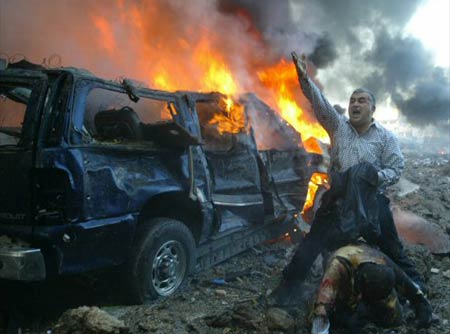
Former Lebanese Prime Minister Rafiq al-Hariri has been assassinated by a suicide bomber. A Shia terrorist group calling itself “Victory and Jihad” has taken credit, and the Lebanese opposition is blaming Syria, of whom Hariri was a critic... Al-Jazeera showed a video of the terrorist organization taking credit for the assassination. The man, identified by Al-Hayat as Ahmad Abu Ads, a Palestinian, read from a written statement, stating that Hariri's killing was necessary to rid "Bilad al-Sham" - Greater Syria - of "unbelievers."
Kirh Sowell's Arab World Analysis
Kirk Sowell goes on further to suggest that this group may not be an external international terrorist as has been suggested by Lebanon but rather a branch of the Hizbollah. His analysis makes some sense considering Al Hariri's anti-Syrian stance - which is one of two Hizbollah sponsors - as well as the statements made against
Lebanon has a long history of political assassination and
It would be interesting to learn what the modus operandi for the latest attack was. Early reports suggested a car bomb and this seems consistent with the level of damage caused. However, the latest reports from Lebanon suggest this is the act of a suicide bomber. As car bombs were typical of Syrian assassination while suicide bombings are a modus operandi that is atypical of Syria or even Hizbollah (which at one point condemned suicide bombings as un-Islamic), the distinction between the two methods has significant repercussions on the "who done it" analysis.
Hundreds of thousands of mourners swarmed the streets of Beirut in a sea of Lebanese flags, chanting slogans against Syria, as the funeral cortege made its way to Mr Hariri's final resting place at a mosque in the centre of the capital.The murder of Mr Hariri, a billionaire businessman and five-time prime minister who resigned over the dominant role Damascus played in his country, stoked fears across the globe of a return to the dark days of the 1975-1990 civil war.
Mr Hariri was killed on Monday with 14 other people, including seven of his bodyguards, when a huge explosion ripped through his motorcade in Beirut, leaving a trail of carnage and destruction not seen in the capital since the war.
"Beirut weeps for its martyr. Beirut salutes Rafiq Hariri," said of the many banners hung in streets in the capital along with black flags and posters of the man regarded as the father of the country post-war reconstruction.
Sowell suggests that this public dissent of Syria might spark the "Orange revolution" of Lebanon. I am not so optimistic, but my fingers are crossed (or tied up in a convoluted multi-ethnic sign - for the politically correct amongst us). Whatever happens, Syria is definitely caught between a rock and a hard place.
The UN's "Oil for Spoils" Program
In the second hearing by the Senate Permanent Subcommittee on Investigations (PSI) on the United Nations Oil-for-Food Program, Chairman Senator Norm Coleman (R-MN) said new evidence suggests Benon Sevan, former Executive Director of the U.N. Office of the Iraq Program, personally received oil allocations worth $1.2 million and called for the United Nations to waive Sevan’s diplomatic immunity from criminal prosecution immediately. The Oil-for-Food program (OFF) was instigated in 1996 to provide food, medicine and humanitarian goods for the Iraqi people through the controlled sale of Iraqi oil, but ultimately generated an estimated $21.3 billion in illegal revenue for Saddam Hussein through smuggling, kickbacks, and other schemes in contravention of U.N. sanctions regimes.
...“The gross mismanagement of almost every aspect of the Oil-for-Food program is simply inexcusable and wasted over $690 million,” Coleman said. “Every organization has its shortcomings, but I cannot recall any organization where the scope of its problems encompassed every basic management skill needed to ensure an effective program. American taxpayers pay close to 22 percent of the U.N.’s operating costs. They need assurances that their tax dollars are well spent, especially in light of the fact that sanctions will likely be imposed upon rogue nations in the future.”
Senator Norm Coleman Website
This goes to the heart of the case for invading Iraq. The status quo that existed at the time was just not a viable alternative. I have heard many criticisms of the war for Iraq, and many have their merits, but I have yet to hear a viable alternative to the confrontation.
- Lifting the sanction would have set a destructive precedent and as such was not an option;
- Keeping the sanctions in full would have killed many more Iraqis. Even if you accept Iraqi statistics, over 10 times more people died as a result of sanctions (which no longer exist) than did in the war and its aftermath; And
- The Oil for Food program put the oil in the wrong hands and the food in the wrong mouths.
Tuesday, February 15, 2005
Dreading Democracy
When it turned out that the streets of Baghdad were not filled with blood, when it turned out that the only stain on that day was on the voters’ fingers (and it was purple and not red), my dear newspaper threw Iraq’s landmark elections to the bottom of its page. What a shame.It would seem that Arab dictatorships are very converned about Iraq's democratic triumph inspiring repeats in the rest of the Arab world in much the same way as Belarus is concerned about the spillover effect from Kiev (For more on this, read ZUBR). Freedom is infectious!
Why are they afraid of Iraq’s elections? Are they afraid to show that America’s plan might look as if it is working? Are they afraid lest people recognize that they were ranting on the wrong side ever since Saddam’s statue fell? Or are they afraid to show that yesterday’s winners did not win by 99.99999%?
One correction though - Saddam Hussein did not get 99% of the vote. In fact the figure was 104%
Monday, February 14, 2005
Valentines Day Special: Iran does not love Israel
05:50 AEDT Mon Feb 14 2005
AP - An Iranian foreign ministry spokesman said it won't recognise Israel and it's not ready to compromise on its position.
Iran and Israel have been bitter enemies for years - Iran's supreme leader Ayatollah Ali Khamenei has called Israel a "cancerous tumour" that must be wiped out from the Middle East - but European leaders have recently suggested to Iran that it recognise Israel.
"No. We don't recognise Israel ... and we are not ready to compromise over this with any country," Foreign Ministry spokesman Hamid Reza Asefi told reporters.
Khamenei, who has the final say on all state matters, has repeatedly said the destruction of Israel is the only way to solve the problems of the Middle East.
But other Iranian officials have signalled a softer tone, calling for a free, democratic referendum to decide the fate of the conflict.
US Secretary of State Condoleezza Rice said recently that American differences with Iran go well beyond its nuclear program, saying it was "really hard to find common ground with a government that thinks Israel should be extinguished".
Iraqi democracy wins!
A Kurdish alliance was second with 2.17 million votes, while third place went to interim Prime Minister Iyad Allawi's list with
about 1.16 million.
The commission said 58 percent of the country's registered voters cast ballots.
Commission member Farid Ayar told reporters, "Today marks the birth of a new Iraq and a free people."
Radio Free Iraq
See also Iraq Votes 2005
UPDATE 2: Mithal Al-Alousi
January 28, 2005
Profile of an Iraqi Politician
By James J. Na
"I would like to thank the United States for liberating Iraq from Saddam Hussein's terror," said the quiet man on the podium. There was a momentary, almost stunned silence, which was quickly followed by a raucous cheer from the audience. The place was Herzliya, Israel -- yes, Israel -- and the speaker was Mithal al-Alusi, then the director general of the Supreme National Commission for De-Baathification in Iraq.
Last September, I attended a conference on counter-terrorism in Herzliya, which drew security experts, military and law enforcement officers, policymakers and researchers from around the world. Al-Alusi's participation -- in an event taking place in Israel -- was not much heralded before the conference. He seemingly slipped into the proceedings, made a plainspoken declaration devoid of any bluster and then discussed the prospect of stability in Iraq.
Al-Alusi's words and action were both daring and significant. Here was an official from the "new" Iraq who publicly thanked the United States for liberation and dared to visit Israel openly. I excitedly called my wife back in the United States, hoping that she caught press coverage of this development.
There was not much coverage in the Western media. In fact, I had to do some digging to find an odd article or two about it later.
My wife's reaction at the time, characteristic of her practicality, was "Does he have any family?"
Indeed, as the news reached Iraq, al-Alusi's family had to flee from home under terrorist death threats. He was expelled from his political party (he had been a spokesman for Ahmed Chalabi's Iraqi National Congress at one time) and was stripped of his government position and security protection, ostensibly for violating Iraq's old Baathist injunction against visiting Israel. An arrest warrant soon followed. He was quietly told to leave the country or face being jailed together with Baathist murderers, meaning a certain death.
Al-Alusi was previously exiled for 27 years for working against Saddam's tyranny, so he was not about to leave the country again precisely when it finally had a chance for freedom. He returned to Iraq, vowing not to be cowed by terrorists. Eventually, the Iraqi interim government realized the ridiculousness of the charge and quietly dropped the indictment. Still al-Alusi has remained under the terrorist gun since and has survived repeated attempts on his life, the last a grenade attack on his house just this month.
Al-Alusi was born in 1953 to an Arab Sunni family of educators in al-Anbar province of Iraq. These days, like many other Iraqis interested in having a say in shaping the nation, he is busy organizing and running a political party. The platform of his new party, the Democratic Party of Iraqi Nation (www.dpin-iraq.org), is to institute a stable government based on "a liberal constitution and free economy," by which he means "no borders for [technical] know-how and open doors for real investment, for example, to build a modern Iraqi oil industry." He considers a strategic alliance with the United States indispensable for Iraq.
Al-Alusi also thinks that Iraq should normalize its relationship with Israel. He told me recently "There is a need to be far away from fanatical ideas, and it's time for Iraq to have politics based on reality." He went on, "The reality is that Israel is a fact, and I cannot accept Iraqi politics based on Palestinian or Syrian interests." Al-Alusi elaborates that Iraq and Israel share common strategic interests and should cooperate on economic and technical issues.
He is openly critical of some countries. He laments, "When Saddam was inflicting terror on the Iraqi people, no Arab or Islamic country supported the Iraqi people against Saddam. The reality was that these countries supported Saddam against the Iraqi people. France, Germany and Russia did the same."
In comparison, he says, "I saw in Israel that 30 percent of Israeli citizens were of Arab origin, and that they had more rights than other Arabs in their own countries." With Iran looming on Iraq's eastern border, he thinks a relationship with Israel can serve as a strategic balance to "keep our new Iraq safe." He explains, "We cannot live in 2005 and still think like in 1005. The strategic relationships [with the United States and Israel] can be a pole to protect human rights, democracy and peace."
As Iraqis get ready to vote in a free election for the first time in at least fifty years, al-Alusi's party is fielding a modest slate of 24 candidates. He does not expect miracles this Sunday. He says, "We started the DPIN in 3 months, with no financial or government support. The only thing we have is our vision. That means even if we win only one seat, it will be a great event."
Even as Western media attention is fixated on terrorist attacks -- real voter intimidations and disenfranchisements, not the imaginary kind we often hear about in the US media -- and other negative news, there are new Iraqi politicians like al-Alusi who are working quietly but energetically to translate their ideals into practice.
I lived through the tumultuous democratization of South Korea from a military dictatorship, so I like to think that I know something of the price of democracy firsthand. Yet, I believe that the upcoming Iraqi election will be perhaps the greatest example of a burgeoning democracy I will have witnessed.
James J. Na is a senior fellow in foreign policy at Discovery Institute in Seattle and runs the "Guns and Butter Blog."
Article from RealClearPolitics.com
James Na's posts in his blog Guns and Butter Blog on the subject are a must read.